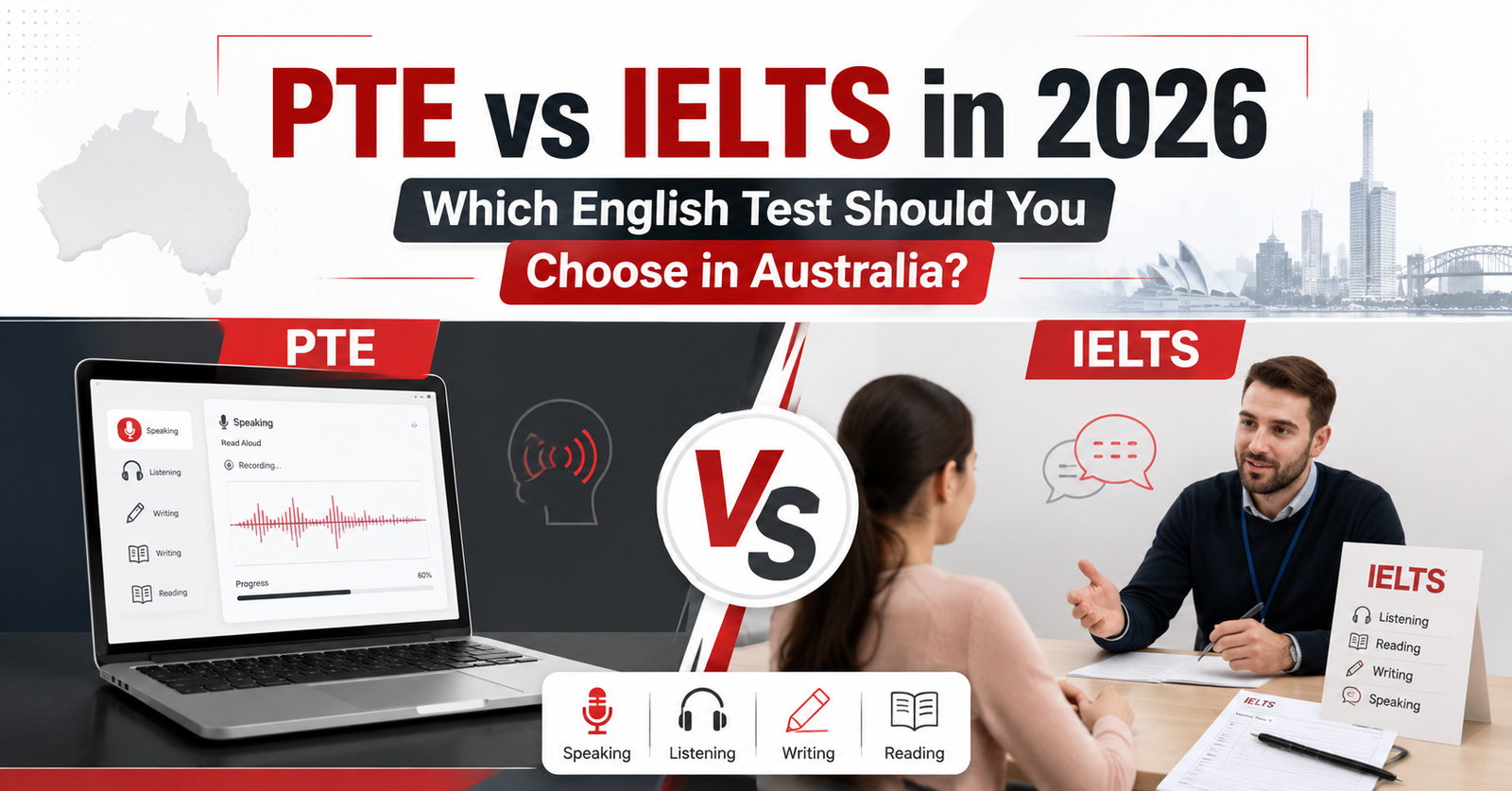
PTE vs IELTS in 2026: Which English Test Should You Choose in Australia?
“Is PTE easier than IELTS?”
It is one of the most common questions English test candidates ask.
It is also the wrong first question.
The better question is:
In 2026, both PTE Academic and IELTS remain major English proficiency options for people pursuing study, professional and migration goals in Australia.
For Australian visa purposes, the Department of Home Affairs currently lists both PTE Academic and IELTS Academic/General Training among accepted tests when the relevant requirements are met and tests are undertaken at secure test centres. Exact score and evidence requirements depend on the visa subclass.
This guide will help you compare PTE vs IELTS based on how the tests actually work.
PTE vs IELTS: Quick Comparison
| Factor | PTE Academic | IELTS |
|---|---|---|
| Delivery | Computer-based | Moving to computer delivery |
| Speaking | Recorded into microphone | Interactive speaking assessment |
| Scoring | 10–90 scale | Band score 0–9 |
| Core Skills | Reading, Writing, Listening, Speaking | Reading, Writing, Listening, Speaking |
| Best For | Candidates comfortable with computers and recorded speaking | Candidates who prefer conversational speaking |
| Preparation | Strong familiarity with integrated computer tasks | Strong module-by-module preparation |
| Retake Feature | Full test retake | Eligible candidates may use One Skill Retake |
Your skills determine which feels easier.
PTE Academic in 2026
PTE Academic is computer-based and uses a 10–90 scoring scale.
Pearson states that PTE uses automated scoring, with some complex responses potentially receiving human review before the automated result is finalised.
PTE may suit candidates who:
- Are comfortable using computers
- Prefer speaking into a microphone
- Like structured question types
- Can maintain concentration across integrated tasks
- Prefer practising through digital mock tests
Current Speaking & Writing question types include:
- Read Aloud
- Repeat Sentence
- Describe Image
- Retell Lecture
- Answer Short Question
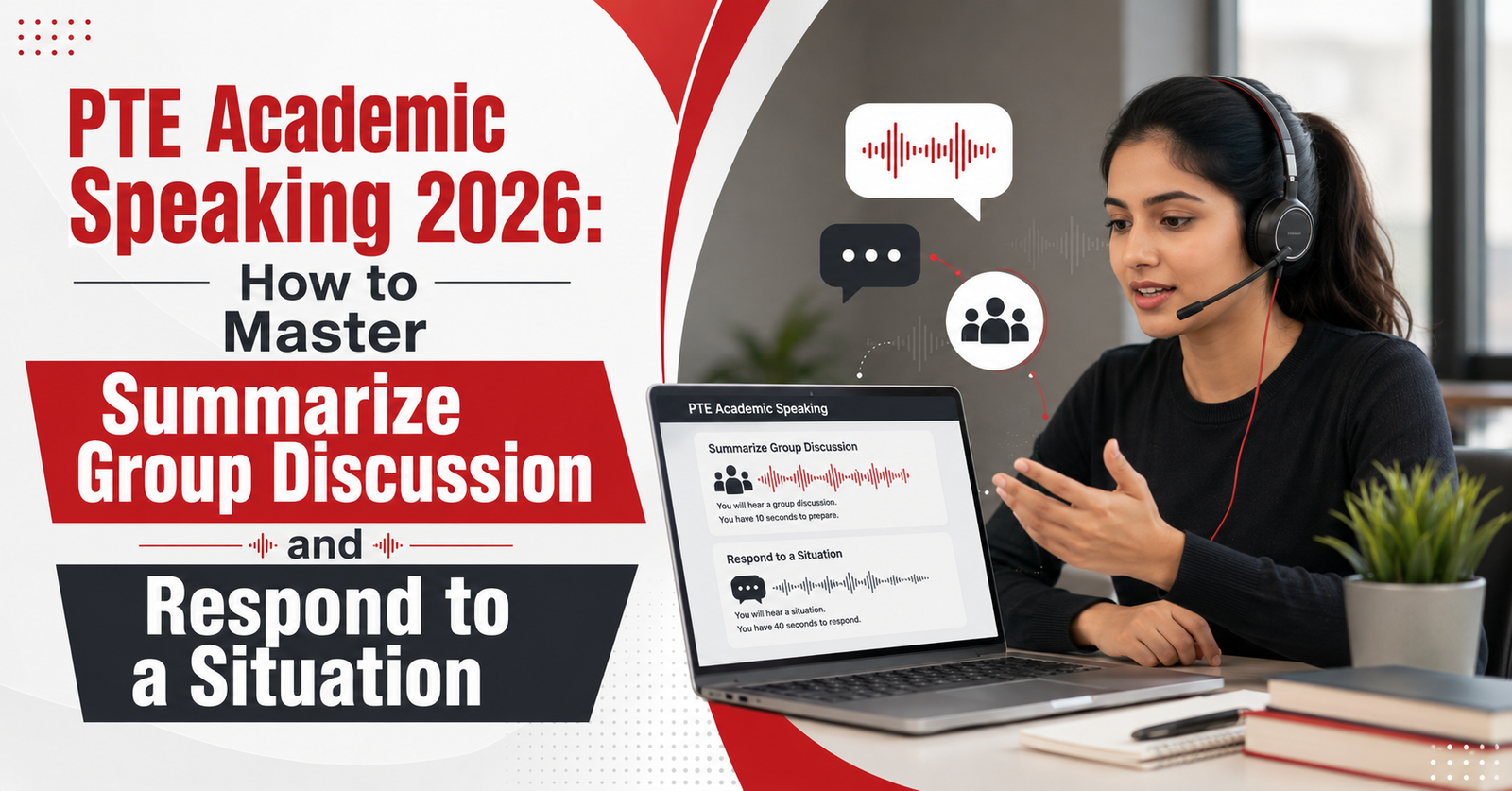
- Summarize Group Discussion
- Respond to a Situation
- Summarize Written Text
- Write Essay
If PTE seems suitable for your learning style, explore PTE Coaching in Perth .
IELTS in 2026
IELTS assesses the same four broad language skills:
- Listening
- Reading
- Writing
- Speaking
However, the testing experience differs from PTE.
One of the biggest differences is Speaking.
IELTS Speaking involves an interactive speaking assessment rather than recording every speaking response into a computer microphone.
Some students find conversation easier because they naturally respond to another person.
Others become nervous in direct interaction and prefer PTE's microphone-based environment.
Neither preference indicates better English. It simply affects how comfortable you feel demonstrating it.
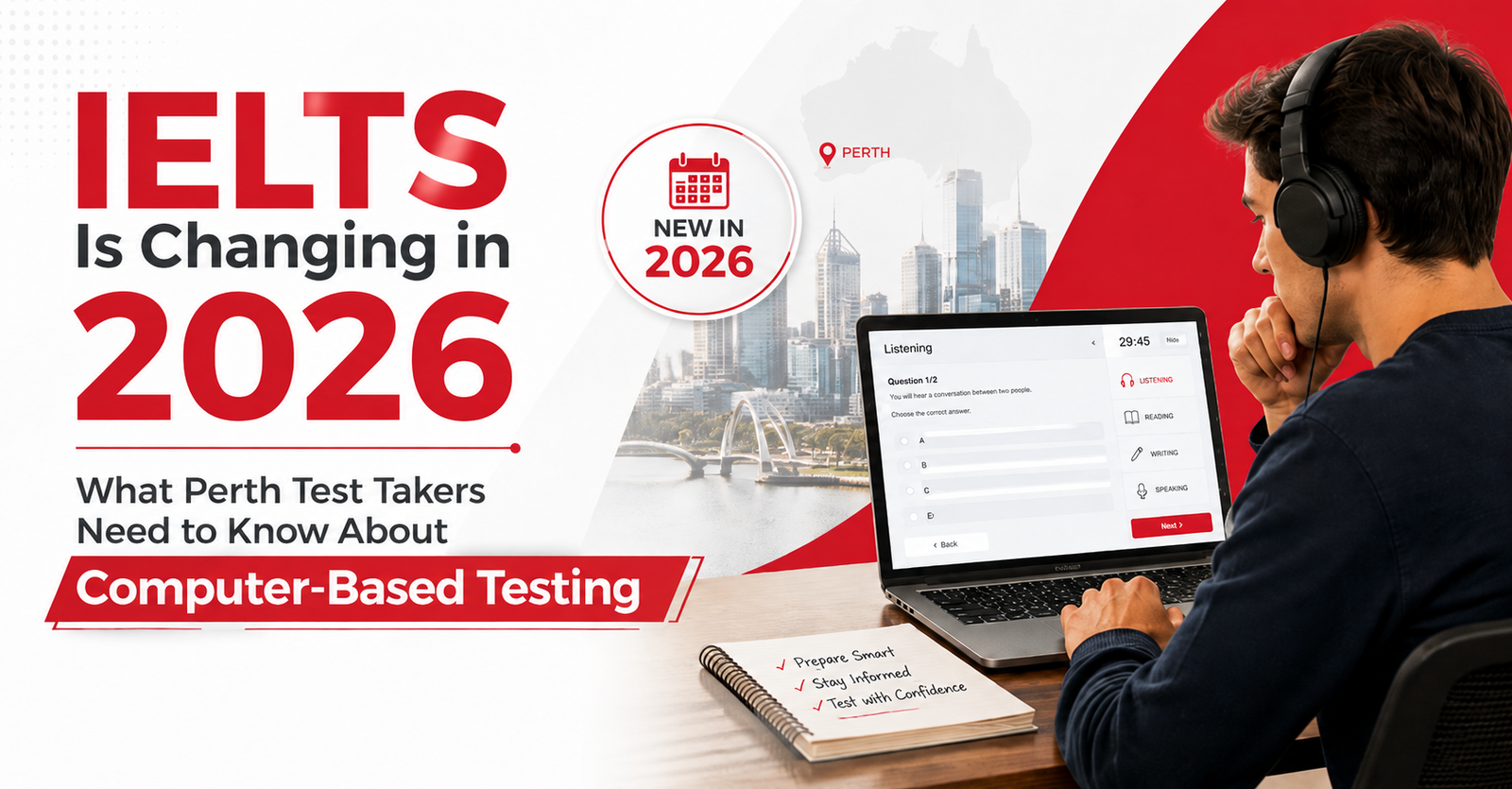
IELTS also announced an important delivery change for 2026: from mid-2026, IELTS is moving away from fully paper-based testing toward computer-delivered tests, with exact timelines varying by market. A Writing on Paper option is being introduced in selected markets.
Students considering IELTS can explore IELTS Coaching in Perth .
Speaking Style
This is often the biggest deciding factor.
Choose PTE If:
You are comfortable:
- Speaking into a microphone
- Recording answers without conversational feedback
- Following strict computer prompts
- Thinking and responding quickly
Choose IELTS If:
You prefer:
- Conversational interaction
- Responding naturally to questions
- Explaining your opinions in dialogue
- Speaking to another person
Computer Confidence
Historically, candidates sometimes chose IELTS because they preferred paper.
That distinction is becoming much less important.
With IELTS moving toward computer delivery in 2026, candidates choosing either test increasingly need good basic computer-test skills.
You should be comfortable with:
- Typing
- Reading from screens
- Navigating questions
- Using headphones
- Maintaining concentration digitally
Scoring System
PTE reports scores on a 10–90 scale, while IELTS uses the familiar 0–9 band scale.
Pearson publishes research comparing PTE Academic and IELTS Academic scores, but Pearson explicitly warns that comparison tables should not be treated as university or visa score requirements. Governments and institutions set their own requirements.
Official requirements can change.
Australian Visa Requirements
The Australian Department of Home Affairs changed its approved English-language test arrangements from 7 August 2025.
For tests taken from that date, the Department currently lists several accepted secure-centre tests, including:
- IELTS Academic
- IELTS General Training
- PTE Academic
- Other approved English tests
Home Affairs also states that fully online or at-home English tests are not accepted as evidence for Australian visa purposes.
Your required score depends on your particular visa pathway.
For immigration advice, speak with an appropriately qualified migration professional.
For English test preparation, focus on reaching the score officially required for your pathway.
One Weak Skill
IELTS has one important feature for eligible candidates: One Skill Retake.
If you perform well in three IELTS sections but miss your target in one, you may be eligible to retake only that skill rather than taking all four again.
IELTS states that One Skill Retake generally needs to be taken within 60 days of the original eligible full test and is limited to one retake per original test. Acceptance should still be checked with the relevant organisation or visa requirement.
Who Should Consider PTE or IELTS?
Who Should Consider PTE?
- Are comfortable with computers
- Prefer speaking without a face-to-face interviewer
- Adapt well to structured question formats
- Are comfortable integrating listening, speaking, reading and writing skills
- Improve effectively through repeated digital mock testing
Read our detailed guide to PTE Speaking in 2026 before making your decision.
Who Should Consider IELTS?
- Prefer conversational Speaking
- Feel comfortable discussing ideas with an examiner
- Understand the IELTS band system
- Prefer IELTS-style Reading and Writing tasks
- Value the possibility of One Skill Retake where eligible
You should also read our guide to IELTS changes in 2026 so you understand the move toward computer delivery.
Stop Asking Which Test Is Easier
There is no useful universal answer.
One student may struggle with PTE Repeat Sentence but perform strongly during an IELTS conversation.
Another candidate may become extremely nervous speaking with an IELTS examiner but speak confidently into a PTE microphone.
Take a Diagnostic Test Before Deciding
Before paying for your official exam, assess yourself.
Do you communicate better conversationally or through recorded responses?
Can you organise essays clearly under time pressure?
Can you process spoken information while taking effective notes?
How well do you understand complex passages on screen?
Can you type and navigate comfortably under timed conditions?
Your answers will tell you more than generic online opinions.
How High Hopes Can Help
High Hopes provides preparation for both PTE and IELTS, which means your decision does not need to begin with loyalty to one exam.
Start by understanding your strengths.
Then build the right strategy.
High Hopes currently offers both face-to-face and online preparation options and promotes personalised feedback, mock testing and targeted study plans.
Final Verdict: PTE or IELTS?
Choose PTE
Choose PTE if its computer-based structure and microphone speaking style fit you better.
Choose IELTS
Choose IELTS if you perform more naturally in conversational Speaking and prefer its task structure.
But do not make the decision based on the claim:
Make it based on:
That is a much smarter way to choose.
Still Unsure Whether PTE or IELTS Is Right for You?
Experience the High Hopes preparation environment and understand which test format may suit your strengths before committing to your next step.